Hours, directions, entrances and the best time to arrive
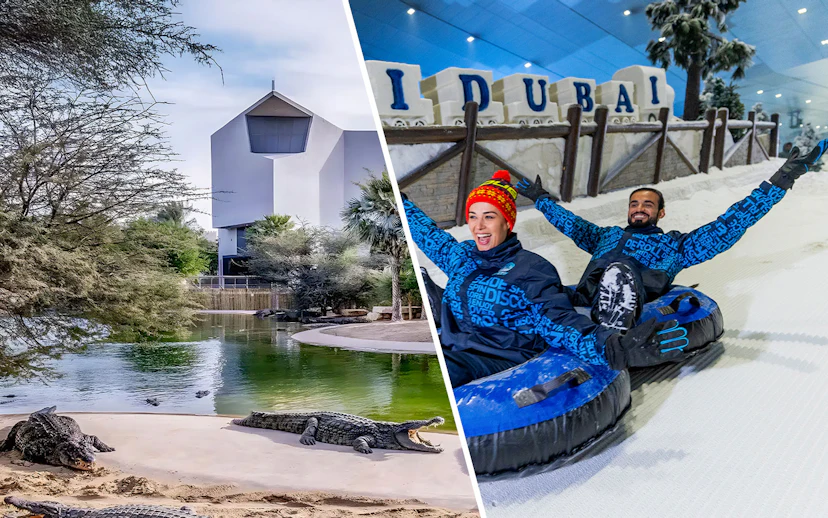
Dubai Crocodile Park is a compact wildlife park best known for its large Nile crocodile habitats, underwater viewing windows, and hands-on baby crocodile encounters. It’s an easy visit in terms of distance, but timing matters more than people expect — arrive without a plan and you can miss the 11:30am or 4:30pm encounter, or the weekend feeding show that changes how active the park feels. This guide helps you time your visit, choose tickets, and move through the park without backtracking.
This is a short, focused attraction, so the best visit usually comes down to choosing the right time rather than setting aside a whole day.
Hours, directions, entrances and the best time to arrive
Visit lengths, suggested routes and how to plan around your time
Compare all entry options, tours and special experiences
How the park is laid out and the route that makes most sense
Nile crocodile lagoons, baby crocodile encounter, underwater aquarium
Restrooms, lockers, accessibility details and family services
Dubai Crocodile Park sits in the Mushrif area beside Mushrif Park, about 30 minutes from Downtown Dubai and closer to Mirdif and the airport.
Tripoli Street, Mushrif, Dubai, United Arab Emirates
→ Open in Google Maps
Full getting there guide
There’s one main entrance, and most visitors overthink it — the real choice is less about entrance and more about arriving before the encounter or feeding times you want.
Full entrances guide
When is it busiest? Friday–Sunday from about 3:30pm onward, plus winter school holidays and Eid periods, are the busiest windows because families time visits around the feeding demo and late baby crocodile encounter.
When should you actually go? Arrive between 10am and 11:30am on a weekday if you want quieter boardwalks, easier photos, and time to catch the first baby crocodile encounter before the day heats up.
| Ticket type | What's included | Best for | Price range |
|---|---|---|---|
Standard admission | Park entry + crocodile habitats + underwater aquarium + Natural History Museum + scheduled baby crocodile encounter + weekend feeding demo | A short standalone visit where you want the full park without extra logistics | From AED 95 |
Child admission | Child entry + crocodile habitats + underwater aquarium + museum + scheduled encounters | Visiting with children up to the age of 12 years and wanting the same experience at a lower entry price | From AED 75 |
Ticket with round-trip transfers | Park entry + hotel transfers | Staying in central Dubai without a car and wanting to avoid the metro-plus-taxi shuffle to Mushrif | From AED 165 |
Dubai attraction pass | Park entry through a multi-attraction pass + access to other selected Dubai attractions | Planning 3 or more paid attractions and wanting Crocodile Park to be one stop in a bigger sightseeing plan | |
Combo ticket | Park entry + entry to a second Dubai attraction | Fitting Crocodile Park into a half-day or full-day plan and wanting to save versus booking both separately |
The park works as a compact, mostly outdoor loop with 3 main zones, and 1.5–2 hours is enough for the highlights while 2.5 hours covers everything at an easier pace. Crowd flow matters most around the scheduled encounters, so don’t save every indoor stop for the end.
Suggested route: Start with the outdoor lagoons while the light is good, move into the aquarium before the heat builds, then time the museum and encounter area around the 11:30am or 4:30pm session so you don’t have to double back.
💡 Pro tip: Take a photo of the entrance map before you walk to the first lagoon — most visitors follow the crocodile decks and only realize later that the museum sits slightly off the main flow.
Get the Dubai Crocodile Park map / audio guide


Species: Nile crocodile
This is the core of the visit — large adults spread across sandbanks, islands, and shallow water in a habitat designed to feel more like an African river setting than a standard enclosure. The scale is what catches people off guard, especially when several 5-meter crocodiles are visible at once. Most visitors look for movement, but the stillness is part of the point — you’re seeing ambush predators exactly as they conserve energy.
Where to find it: Along the main outdoor boardwalk loop immediately after the entrance area.
Habitat: African lake-themed aquarium
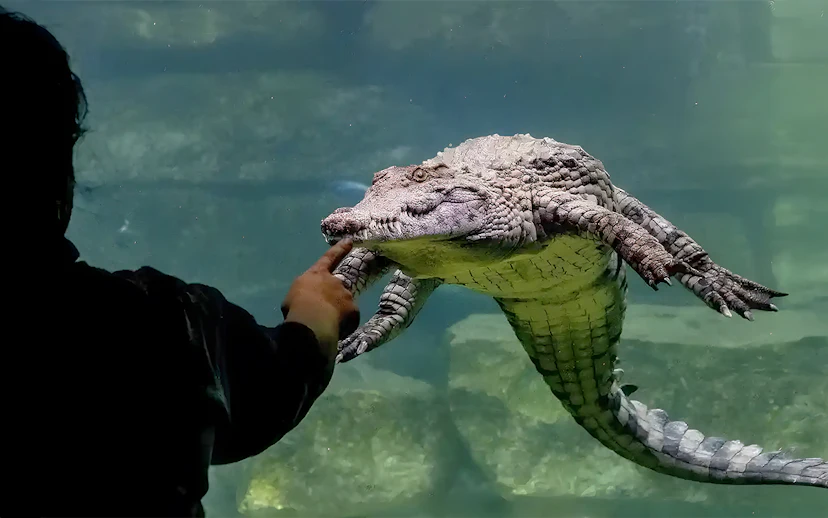
This indoor viewing section changes how you understand the park because it shows crocodiles where they’re most graceful, not just where they’re most intimidating. Underwater, their size, tail power, and slow, controlled movement become much clearer. What people rush past is the contrast with the fish sharing the water — it makes the crocodiles’ control and precision more obvious.
Where to find it: Off the main outdoor route, in the climate-controlled indoor section connected to the central habitat area.
Experience type: Supervised juvenile crocodile interaction
This is one of the most memorable parts of the park, especially if you’re visiting with children. Staff bring out a juvenile crocodile during scheduled sessions and explain how young crocodiles are handled and monitored. The thing most visitors miss is that it moves quickly — if you arrive exactly at start time, you may already be several rows back.
Where to find it: At the encounter area used for the 11:30am and 4:30pm sessions.
Focus: Crocodilian evolution, biology, and conservation
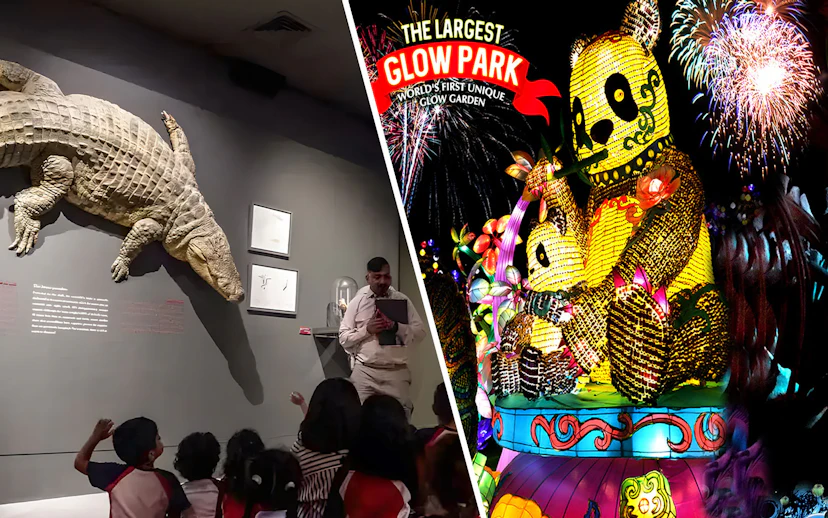
The museum is what turns the visit from an animal stop into a better wildlife experience. You’ll get context on crocodile ancestry, anatomy, bite force, and survival over millions of years. Many visitors leave the outdoor habitats too soon and only later realize this room explains much of what they just saw.
Where to find it: Near the later part of the route, close to the indoor interpretive area and exit flow.
Experience type: Staff-led feeding demonstration
If you want to see the crocodiles at their most active, this is the moment to plan around. The shift from near-motionless basking to sudden bursts of speed makes the animals feel completely different. What people underestimate is how quickly the best viewing spots go, especially on Friday–Sunday afternoons.
Where to find it: At the main adult habitat viewing area during the scheduled weekend feeding window.
Life stage: Hatchlings and young crocodiles
The smaller crocodiles are easy to overlook because the huge adults dominate the visit, but these enclosures make the life-cycle story much richer. You’ll get a better sense of size progression and why the baby encounter matters. Many people skip them simply because they’re following the outdoor loop too quickly toward the biggest viewing decks.
Where to find it: Near the museum and encounter section rather than the main outdoor lagoon line.
Dubai Crocodile Park works well for children because the visit is short, visual, and built around one animal with a clear wow factor rather than a huge all-day zoo layout.
Personal photography is one of the strengths of this visit, and most visitors spend plenty of time shooting the outdoor lagoons, aquarium windows, and encounter areas. Handheld photos work best because some paths and viewing decks are narrow, and it’s smart to give staff room during the supervised baby crocodile sessions. If you want the cleanest shots, weekday mornings are better than the weekend feeding window, when more people gather at the rails.
Distance: About 500 m — 5-minute walk
Why people combine them: It’s the easiest same-area add-on, especially if you want a picnic, open green space, or somewhere for children to run around after a short wildlife visit.
Book / Learn more
Distance: About 5 km — 10-minute drive
Why people combine them: One gives you a focused 1.5–2 hour crocodile experience, while the other covers a broader full-day animal lineup, so together they make sense for a wildlife-heavy day in cooler months.
Book / Learn more
Aventura Parks
Distance: About 2 km — 5-minute drive inside the wider Mushrif area
Worth knowing: It’s a strong add-on if you’re visiting with older children who still want an active, outdoorsy second stop after the park.
City Centre Mirdif
Distance: About 7 km — 15-minute drive
Worth knowing: This is the easiest practical stop for a proper meal, air-conditioning, or a low-effort indoor follow-up after a heat-heavy visit.
Mushrif and Mirdif are practical rather than central. They work best if you have a car, want quick airport access, or are building a quieter, family-focused Dubai trip away from the beachfront zones. For most short stays, this is not the most convenient sightseeing base.
Most visits take 1.5–2 hours. That’s enough time for the outdoor lagoons, underwater aquarium, museum, and one scheduled encounter. If you want to wait for the Friday–Sunday feeding demo, stop at the café, or move at a slower family pace, expect closer to 2.5 hours.
No, you usually don’t need to book far in advance. Dubai Crocodile Park is one of those attractions many people book the same day or 1–2 days ahead. It’s still worth reserving early for winter weekends, school holidays, and Eid periods, when family traffic is noticeably higher.
Arrive 10–15 minutes before the time window you care about most. That matters less for entry queues and more for the scheduled experiences, especially the 11:30am and 4:30pm baby crocodile encounters. For the best feeding-show view on Friday–Sunday, give yourself a bit more buffer and be in place by about 3:50pm.
Yes, a small backpack or day bag is fine. Light is better here, because the route is short, mostly on foot, and outdoors. If you’re carrying water, sun protection, and a camera, that’s practical; full-size luggage or heavy bags will just slow you down on the boardwalk-style viewing areas.
Yes, photography is one of the main reasons people enjoy the park so much. The outdoor habitats, underwater viewing panels, and encounter areas are all good for handheld photos. If you want cleaner shots, go on a weekday morning, because the viewing rails are less crowded than they are during the weekend feeding window.
Yes, group visits work well here, especially school and family groups. The park is compact enough that you won’t spend half the visit waiting for people to catch up, and schools often use it for structured educational outings. Just remember that children up to the age of 12 years need adult supervision.
Yes, it’s one of the easier wildlife attractions in Dubai to do with children. The visit is short, the route is manageable with a stroller, and the baby crocodile encounter gives kids a clear focal point. It’s a better fit for a half-day family outing than for an all-day animal park experience.
Yes, the main route is wheelchair accessible. Paths are smooth, ramps are available at key transitions, accessible restrooms are on-site, and courtesy wheelchairs are available on request. It’s a more manageable layout than a large safari-style park, especially if you want a shorter visit without long distances.
Yes, food is available on-site and nearby. The Okavango café spaces inside the park cover snacks, drinks, and light meals, while City Centre Mirdif is the easiest nearby option if you want a fuller sit-down meal after your visit. Many families time food around the 11:30am encounter or after the park.
Yes, that’s one of the park’s signature experiences. The supervised baby crocodile encounter usually runs twice daily at 11:30am and 4:30pm, and it’s included with standard admission. Arrive a little early if it matters to you, because these sessions attract small crowds and the interaction moves quickly.
Late afternoon is the most eventful time, especially on Friday–Sunday. That’s when the feeding demo makes the crocodiles visibly more active, and the second baby crocodile encounter also happens later in the day. If you care more about space and photos than movement, weekday mornings are the better trade-off.
The easiest no-car route is the Metro plus a short taxi. Take the Red Line to Al Rashidiya Metro Station, then continue by taxi for about 10 minutes. Bus connections are possible, but they usually still involve a walk, which feels far less pleasant in Dubai heat than the metro-and-taxi combination.


Dubai’s only park with 250 Nile crocodiles, aquarium & museum in one ticket.
Inclusions #
Entry to Dubai Crocodile Park
Access to Park journey
Access to Crocodile Museum
Access to Crocodile Aquarium


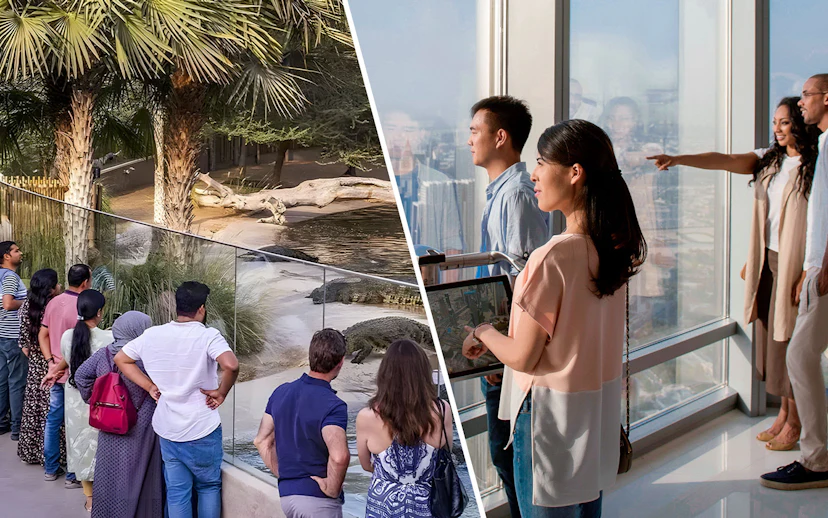
Save more with this incredible combo, offering crocodile encounters and Burj Khalifa views in one ticket.
Inclusions #
Dubai Crocodile Park
Entry to Dubai Crocodile Park
Access to Park Journey
Access to Crocodile Museum
Access to Crocodile Aquarium
Burj Khalifa At the Top
Access to Burj Khalifa Levels 124 & 125
Access to the telescopes at 2 observation decks
Dubai Crocodile Park
Burj Khalifa At the Top


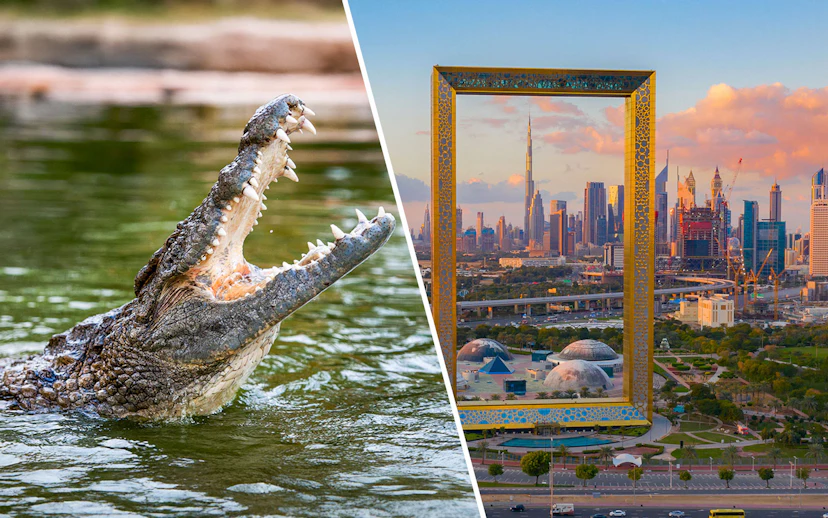
Meet Nile crocodiles and see Dubai’s old and new views with one great value combo ticket.
Inclusions #
Dubai Crocodile Park
Entry to Dubai Crocodile Park
Access to Park Journey
Access to Crocodile Museum
Access to Crocodile Aquarium
Dubai Frame
Dubai Crocodile Park
Dubai Frame


Dubai Crocodile Park
Dubai Miracle Garden
Inclusions #
Dubai Crocodile Park
Entry to Dubai Crocodile Park
Access to Park Journey
Access to Crocodile Museum
Access to Crocodile Aquarium
Dubai Miracle Garden


Dubai Garden Glow
Dubai Crocodile Park
Inclusions #
Dubai Garden Glow
Entry to Dubai Garden Glow
Access to Dinosaur Park
Access to Glow Park
Dubai Crocodile Park
Entry to Dubai Crocodile Park
Access to Park Journey
Access to Crocodile Museum
Access to Crocodile Aquarium